
Picture this: You’re starving, late for a meeting, and staring into your fridge. Leftovers. The good kind. But cold. You punch a few buttons on the microwave, and in a couple of minutes, a culinary resurrection occurs. But have you ever stopped to wonder how that happens? How does a box, using just invisible waves, heat food from the inside out?
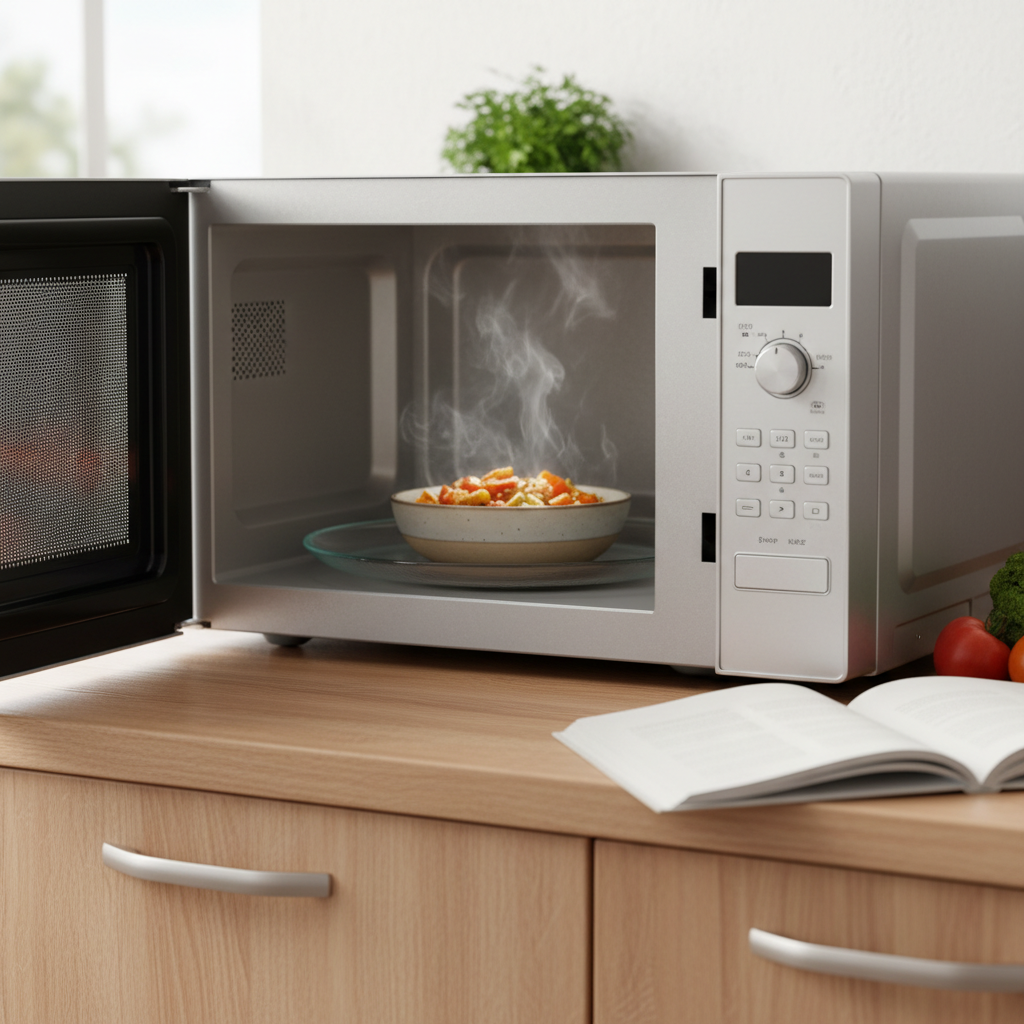
We’re going to pull back the curtain on this everyday marvel. We’ll skip the jargon, get rid of the textbooks, and just figure out how the microwave oven actually works. Let’s get started.
The Big Picture: It’s All About Water
At a basic level, this works because of water. Not the water in the food, but how the food’s water molecules react to invisible waves. Think of it like this: water molecules are tiny magnets, constantly vibrating. A microwave oven makes those water magnets go absolutely crazy. As they vibrate, they bump into each other, creating friction. And friction equals heat.
That’s the core idea. The microwave oven generates these invisible waves (microwaves) that are perfectly tuned to make water molecules go wild. Since most foods contain water, they heat up rapidly. Let’s break it down into its parts to see how this magic happens.
The Key Players: The Anatomy of a Microwave
A microwave oven isn’t complicated. It has a few key players working together in perfect harmony:
- The Magnetron: This is the heart of the operation. It’s a special vacuum tube that generates the microwaves. Think of it as the engine of the whole system.
- The Waveguide: The waveguide is like a tunnel. It’s a metal channel that directs the microwaves from the magnetron into the cooking chamber.
- The Cooking Chamber: This is the main compartment where you put your food. It’s made of metal to contain the microwaves, ensuring they bounce around and cook your food evenly.
- The Turntable: This rotating glass plate ensures that your food cooks evenly. Without it, you’d have hot spots and cold spots.
- The Control Panel: This is where you tell the microwave what to do: how long to cook for, at what power level, and so on.
- The Power Supply: This is the unsung hero. It takes the electricity from your wall and transforms it into the high voltage needed to power the magnetron.
Step-by-Step: How Microwaves Cook Your Food
Let’s walk through the process:
- Power On: When you press the start button, the power supply kicks in, sending high-voltage electricity to the magnetron.
- Microwave Generation: The magnetron, energized by the electricity, starts to generate microwaves – radio waves with a very specific frequency (typically 2.45 GHz).
- Waveguide Direction: The microwaves travel through the waveguide, a metal channel that directs them into the cooking chamber.
- Wave Action: Inside the cooking chamber, the microwaves bounce off the metal walls, creating a chaotic, but effective, environment.
- Water Molecule Excitement: As the microwaves interact with the food, they’re absorbed by the water molecules. These molecules start to vibrate rapidly, generating heat through friction.
- Cooking: The heat spreads throughout the food, cooking it from the inside out.
- Turntable Magic: The turntable rotates the food, ensuring that all parts are exposed to the microwaves and cook evenly.
- Time’s Up: When the timer runs out, the magnetron shuts off, and the microwaves stop.
Common Misconceptions: Debunking the Myths
There are a lot of myths about microwaves. Let’s clear up some of the most common ones:
- Myth: Microwaves cook food from the inside out. The waves penetrate the food to a certain depth and heat the water molecules. While it can seem that way, the outside cooks first, just like in any other form of cooking.
- Myth: Microwaves make food radioactive. Absolutely false. Microwaves are a form of non-ionizing radiation, meaning they don’t have enough energy to damage your cells or make food radioactive.
- Myth: Microwaves destroy nutrients in food. While some nutrient loss can occur, it’s often less than other cooking methods like boiling. The quick cooking time of microwaves actually helps preserve nutrients.
- Myth: You can’t put metal in a microwave. Small amounts of metal, such as a fork, can be okay. However, large pieces or anything with sharp edges can cause sparking and damage the microwave.
Why Small Changes Matter: Usage Habits and Performance
The way you use your microwave oven and the environment around it can significantly affect its performance:
- Food Placement: Arrange food in a way that allows microwaves to reach all parts. Spreading food out on a plate will allow it to cook more evenly.
- Covering Food: Covering food helps retain moisture and ensures more even heating. It also prevents splattering, which makes cleaning easier.
- Power Levels: Use different power levels for different foods. Lower power levels allow for more gentle cooking, which is ideal for delicate items.
- Container Materials: Use microwave-safe containers. Avoid metal, which can cause sparks, and some plastics that can melt.
- Cleaning: Clean your microwave regularly. Food splatters can absorb microwaves and reduce efficiency.
Modern Relevance: Microwaves in the 2020s
Microwaves are evolving. Here’s how they fit into the modern kitchen:
- Smart Microwaves: Wi-Fi-enabled microwaves can be controlled via smartphone apps, allowing you to preheat, adjust settings, and receive cooking notifications.
- Sensor Cooking: Many modern microwaves have sensors that detect the humidity released by food, automatically adjusting cooking time and power levels for optimal results.
- Combination Ovens: Some microwaves combine microwave technology with convection or grilling elements, offering more versatile cooking options.
- Energy Efficiency: While microwaves are already energy-efficient compared to conventional ovens, manufacturers are constantly improving their designs to reduce energy consumption further.
Understanding Helps: A New Mental Model
Now, when you look at your microwave, you’ll see a small powerhouse of science. You know that it uses electromagnetic waves to excite water molecules in food, creating friction and heat. You understand how the magnetron generates the microwaves, how the waveguide directs them, and how the turntable ensures even cooking.
You can explain it to your friends. You can see why covering your food is important and why you should avoid putting metal inside. You are now a microwave master.
FAQ: Your Burning Microwave Questions Answered
Here are some of the most common questions people have about how microwaves work:
1. Can I put any plastic container in the microwave?
No, not all plastics are microwave-safe. Look for containers labeled “microwave-safe.” These are made from materials that won’t melt or release harmful chemicals when heated.
2. Why does my food sometimes cook unevenly in the microwave?
Uneven cooking can be due to a few factors: the food’s shape, how it’s arranged, and whether your microwave has a turntable that’s working correctly. The turntable ensures that all parts of the food get exposure to the microwaves.
3. Is it safe to stand near a microwave while it’s running?
Yes, it is generally safe. Microwaves are designed to contain the radiation. However, it’s always good practice to stand a few feet away from the microwave while it’s in use as a precaution.
4. Why does my microwave sometimes spark?
Sparking usually happens when you put metal objects in the microwave. The microwaves interact with the metal, creating an electrical discharge. This can also happen if the interior of your microwave is dirty or if you’re using a container that isn’t microwave-safe.
5. How do I clean my microwave?
Cleaning your microwave is easy. You can heat a bowl of water with a little vinegar for a few minutes. The steam will loosen food splatters, making them easier to wipe away. Always unplug the microwave before cleaning.
6. Can I reheat food multiple times in the microwave?
Yes, you can reheat food multiple times, but make sure to reheat it thoroughly to kill any bacteria. Each time you reheat, make sure the food reaches a safe internal temperature.
7. Why does my microwave make a buzzing sound?
The buzzing sound is usually from the magnetron, the component that generates the microwaves. It’s a normal sound. If the buzzing is excessively loud or sounds unusual, the microwave could be malfunctioning.
8. Do microwaves use a lot of electricity?
Microwaves are generally more energy-efficient than conventional ovens. They use less power to heat food because they focus the energy directly on the food itself. This makes them a more efficient option for reheating small portions.
Now you know the secret of the microwave! Next time you hit that start button, you’ll have a new appreciation for the science behind your quick meal.
For more insights, check out Energyrevolutionsystem.info.